Cooking Data Ambiguity: Recipes and Rehearsals for Reclaiming Uncertainty
University of Copenhagen Student Centre, Copenhagen · 0 kr.
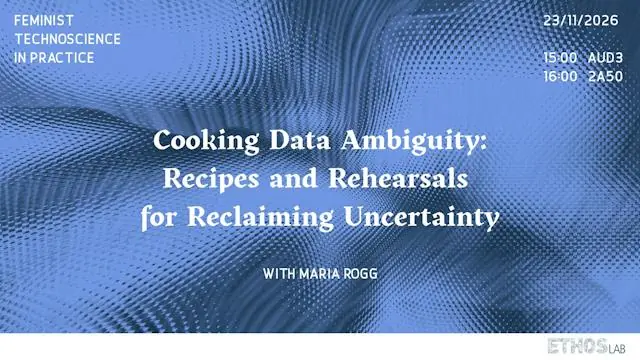
Cooking Data Ambiguity - lecture and workshop: Monday 23 November 2026, 15:00–18:00, University of Copenhagen Student Centre, Copenhagen. Admission is free.
Maria Rogg visits ITU for a lecture and workshop on ambiguity in data culture. The lecture at 15:00 in AUD3 is open to all. The workshop starts at 16:00 in room 2A50 and requires advance ticket reservation.
The lecture "Cooking Data Ambiguity: Recipes and Rehearsals for Reclaiming Uncertainty" (15:00-16:00) examines ambiguity as a critical value in an era of digitally imposed certainty and as a methodological ingredient in feminist care and critique. The main focus is the body in data culture. Body data is increasingly treated as the truth of who we are, but data is always "already cooked", and lived experience is easily reduced. What can it offer to remain in the uncertain, contradictory, and ambiguous when resisting the biometric imaginary? The lecture draws on ethnographic research with artists and designers who use DIY biohacking to enchant technology and imagine the body in new ways. It offers not final answers, but recipes and exercises in holding the unresolved.
The workshop (16:00-18:00) follows the lecture and is an exercise in practicing ambiguity and living with uncertainty, both despite and because of datafication. Data is never raw, whether it is a sensor measurement, a research transcript, or a memory. Participants gather the unresolved, the unsaid, and the unmeasurable and brew it into an elixir.
Participants start from an ambiguous experience with technology from their research or private life - a moment when they felt two things at once. From a speculative scenario, free and creative writing is combined with paired interviews, where participants both interview and are interviewed. Through critical and speculative fabulation, ambiguity becomes something recognizable, shapeable, and usable as a basis for investigation and community rather than a conclusion. Participants decide what they share and leave with their own recipe for working with data ambiguity.
Lectures · Copenhagen 454 in the next 30 days →
 68lectureSat 21.11.Nature Walks - Gentle Mobilization in the Name of Climate Action
 68lectureSat 5.12.Nature Walks - Gentle Mobilization in the Name of Climate Action
 64lectureThu 19.11.Wild About Science - The Riddles of Origin, Life and Consciousness
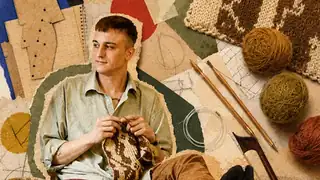 64lectureSat 21.11.Introduction to Knit Design
 63lectureSat 14.11.FUJ Prizes and Method Presentations
 63lectureMon 23.11.Eske Willerslev - The Hunt for the World's Oldest DNA
 100festivalSat 19.6.Country Club - Outdoor Country Music Festival - Copenhagen
 100concertSat 5.12.Breinholt’s GIGA Juleshow
 100concertTue 1.12.Los Fabulosos Cadillacs
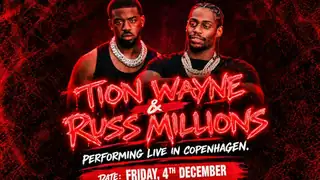 100concertFri 4.12.Tion Wayne & Russ Millions in Copenhagen
 100festivalFri 4.12.BIG BANG Art Show & ROXY JULES concert
 100clubSat 3.4.TAM TAM 2027: NO LIMITS // TAP1